Orders placed before 4 p.m. are processed on the same day.
 Zapłać 60 dni później z PRAGMA GO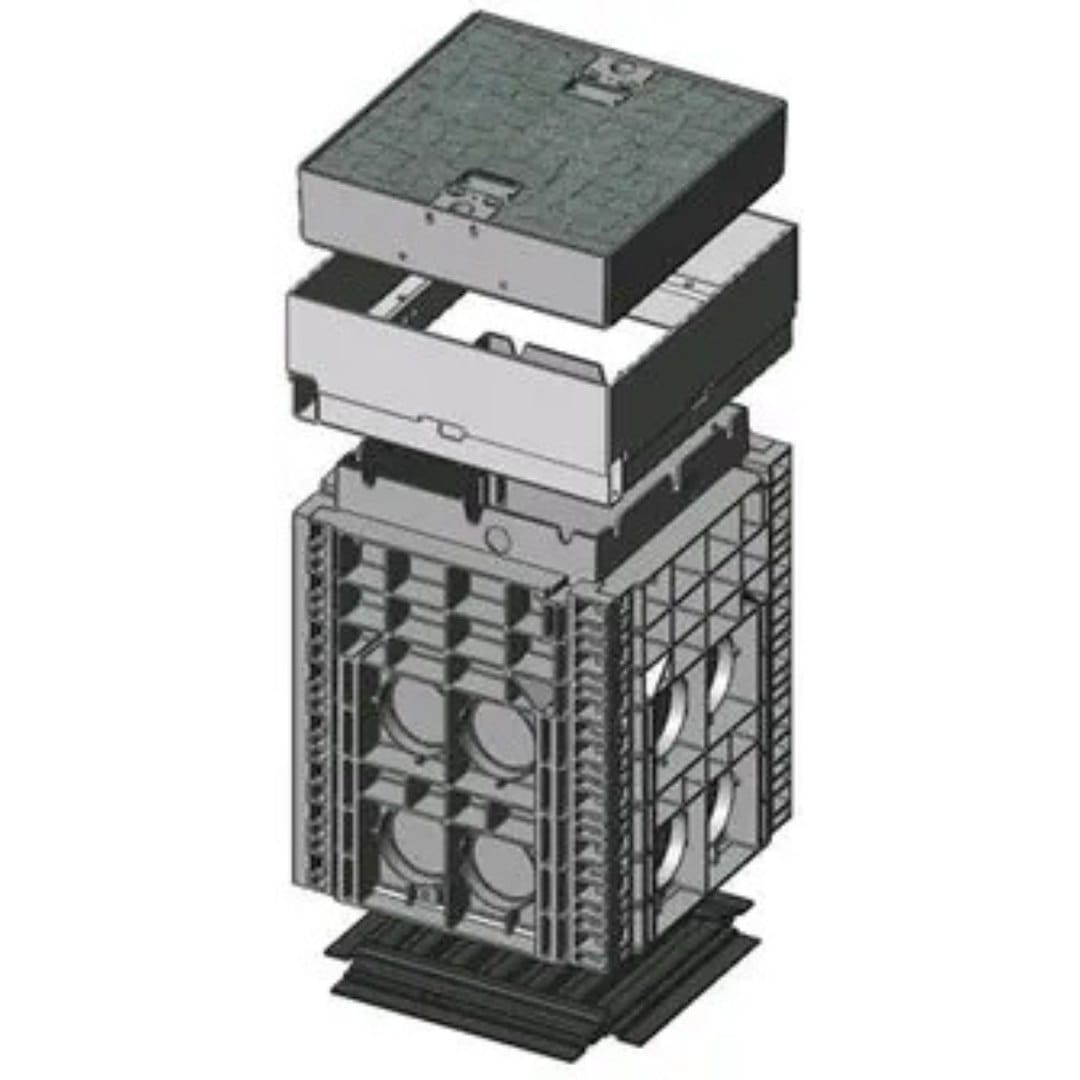
The SK-1 telecommunication cable chamber made of high-quality polycarbonate is a modern and durable alternative to traditional concrete cable chambers used in telecommunication duct systems. Thanks to its design, it can be used both as a through chamber and as a branching chamber in cable infrastructure systems.
The chamber body is manufactured from foamed polycarbonate, which has undergone specialized processing to achieve exceptional mechanical properties and high resistance to environmental factors. This material provides excellent durability while maintaining a significantly lower weight compared to conventional concrete chambers.
The chamber is equipped with four thinning points on each side, allowing the installation of Ø110 mm ducts. Its modular design enables flexible height adjustment according to site conditions and significantly reduces installation time.
The equivalent of the classic SK-1 chamber in the Quality Box product range is the EK 358 K1 model, designed to meet the requirements of modern telecommunication and technical infrastructure installations.
The SK-1 cable chamber is intended for the construction and modernization of telecommunication duct systems. It can serve as a through chamber, distribution chamber, or inspection chamber.
The product is suitable for use in:
The chamber can be installed in:
The chamber body is made of foamed polycarbonate, ensuring excellent mechanical performance and high resistance to damage.
Main material properties:
One of the key advantages of the SK-1 chamber is its modular construction, allowing the chamber height to be adapted to specific project requirements.
Advantages of the modular system:
The chamber is equipped with multiple thinning points enabling fast and convenient cable duct entry installation.
System features:
The SK-1 chamber may be equipped with different types of covers depending on surface conditions and operational requirements.
Available cover options:
Depending on the selected version, the following load classes are available:
The EK358K2 model is a compact version of the SK-1 chamber equipped with a galvanized steel frame and multiple cover variants, intended for demanding operating environments.
Model: EK 358 K1
Type: SK-1 telecommunication cable chamber
Internal dimensions: 400 × 400 mm
External dimensions: 550 × 550 mm
Height: 630 mm (with concrete-filled cover)
Chamber body material: foamed polycarbonate
Duct entry system: thinning points for Ø110 mm ducts
Load class: B125 according to EN 124
Optional load class: D400
Model: EK358K2
Typ: studnia kompaktowa
Internal dimensions: 400 × 400 mm
External dimensions: 540 × 540 mm
Internal height: 630 mm
Total height:
Load class: B125 or D400 according to EN 124
Chamber body: polycarbonate
Frame: galvanized steel
Thinning points:
Approximate weight (depending on version):
The SK-1 polycarbonate cable chamber is a modern solution designed to replace traditional concrete chambers. Thanks to its high material resistance, modular design, and wide configuration possibilities, it provides a reliable solution for demanding infrastructure projects.
The product is particularly recommended for:

|
Pokrywa ciężka klasy B125 z wywietrznikiem do studni SKR-1
P-SKR1-B125-W
5904858988853
|

|
Rama ciężka klasy B125 do studni SKR-1
R-SKR1-B125
5904858988785
|

|
Studnia kablowa SK-1 klasa A15 dwuelementowa / dwuczęściowa + rama + pokrywa pełna
S-SK1-2-A15-R-PP
5904858984060
|

|
Rura wsporcza do studni SKR-1
SKR-1-RURA-WSPORCZA
0000000652
|

|
Klapa / pokrywa do studni SK-1 z wywietrznikiem 50x50cm klasa A15
P-SK1-A15-W
5904858988877
|

|
Studnia kablowa SK-1 klasa B125 dwuelementowa / dwuczęściowa + rama + pokrywa pełna
S-SK1-2-B125-R-PP
5904858984121
|

|
Klapa / pokrywa do studni SK-1 pełna 50x50cm klasa B125
P-SK1-B125-P
5904858988839
|

|
Rama ciężka do studni SK-1 klasa B125
R-SK1-B125
5904858988815
|

|
Pokrywa ciężka klasy B125 do studni SKR-1
P-SKR1-B125-P
5904858988860
|

|
Studnia kablowa SKR-1 jednoelementowa / jednoczęściowa klasa D400 + rama + pokrywa pełna
S-SKR1-1-D400-R-PP
5904858984152
|

|
Pokrywa ciężka klasy D400 pełna do studni SKR-1
P-SKR1-D400-P
5904858989294
|

|
Studnia kablowa SK-1 klasa A15 dwuelementowa / dwuczęściowa z wbetonowaną ramą w części górnej+ pokrywa pełna
S-SK1-2-A15-RK-PP
5904858984046
|

|
Studnia kablowa SKR-1 dwuelementowa / dwuczęściowa Klasa B125 + rama + pokrywa pełna
S-SKR1-2-B125-R-PP
5904858984145
|

|
Studnia kablowa SKR-1 dwuelementowa / dwuczęściowa Klasa A15 + rama + pokrywa wentylowana
S-SKR1-2-A15-R-PW
5904858984022
|

|
Studnia kablowa SK-1 klasa A15 dwuelementowa / dwuczęściowa z wbetonowaną ramą w części górnej+ pokrywa wentylowana
S-SK1-2-A15-RK-PW
5904858982745
|

|
Studnia kablowa SK-1 klasa B125 dwuelementowa / dwuczęściowa z wbetonowaną ramą w części górnej+ pokrywa pełna
S-SK1-2-B125-RK-PP
0000008578
|

|
Rama ciężka klasy D400 do studni SKR-1
R-SKR1-D400
5904858988822
|
We have made every effort to ensure that the above data is correct, but we do not guarantee that the published information does not contain errors, which, however, cannot constitute the basis for any claims.









 Szybki proces.